

David Gordon * Ludwig von Mises Institute
Fascism vs. Capitalism. By Llewellyn H. Rockwell, Jr. Auburn, Ala.: Mises Institute, 2013. 170 pages.
Lew Rockwell offers us in Fascism vs. Capitalism a provocative and insightful diagnosis of the political and economic ills of our time. The situation that we face, he says, is dire; but, fortunately, he does not leave us without remedy. To the contrary, the wisdom of Mises, Rothbard, and their colleagues in the Austrian School offers the means to rescue us, and the inspiring leadership of Ron Paul shows us the way to put their ideas into practice.
As the book’s title suggests, Rockwell finds “fascism” to be the key concept needed to analyze the modern American era. He is quick to deflect an objection:
“Fascism” has become a term of general derision and rebuke. It is tossed casually in the direction of anything a critic happens to dislike. ... But fascism is a real concept, not a stick with which to beat opponents arbitrarily. The abuse of this important word undermines its true value as a term referring to a very real phenomenon, and one whose spirit lives on even now.
What, then, is fascism? To Rockwell, it is an aggressive nationalism and imperialism, together with domination of the economy by the state.
The state, for the fascist, is the instrument by which the people’s common destiny is realized, and in which the potential for greatness is to be found. Individual rights, and the individual himself, are strictly subordinate to the state’s great and glorious goals for the nation. In foreign affairs, the fascist attitude is reflected in a belligerent chauvinism, a contempt for other peoples, and a society-wide reverence for soldiers and the martial virtues.

To what extent does this conception of things apply to contemporary America? Rockwell demonstrates in detail that it applies all-too-well. Following one of his great predecessors, the Old Right stalwart John T. Flynn, he distinguishes eight “marks of fascism,” and for each one he illustrates its contemporary relevance.[1] We have space to discuss only a few of these, but the reader is urged to read Rockwell’s complete discussion to grasp fully the strength of his analysis.
When the ordinary person thinks of fascism, he probably identifies it with the cult of the Leader, in the style of Hitler and Mussolini.
I [Rockwell] wouldn’t say that we truly have a dictatorship of one man in this country, but we do have a form of dictatorship of one sector of government over the entire country. The executive branch has spread so dramatically over the last century that it has become a joke to speak of checks and balances. What the kids learn in civics class has nothing to do with reality. ... As for the leadership principle, there is no greater lie in American public life than the propaganda we hear every four years about how the new president/messiah is going to usher in the great dispensation of peace, equality, liberty, and global human happiness. The idea here is that the whole of society is really shaped and controlled by a single will — a point that requires a leap of faith so vast that you have to disregard everything you know about reality to believe it.
The increased power of the executive branch has been accompanied by a policy of militarism and war.
Ronald Reagan used to claim that his military buildup was essential to keeping the peace. The history of US foreign policy just since the 1980s has shown that this is wrong. We’ve had one war after another, wars waged by the United States against noncompliant countries, and the creation of even more client states and colonies.
US military strength has led not to peace but the opposite. It has caused most people in the world to regard the United States as a threat, and it has led to unconscionable wars on many countries. Wars of aggression were defined at Nuremberg as crimes against humanity.
At the heart of fascism lies state control of the economy. As Mises long ago pointed out, socialism can come about while the form of capitalism remains. In this type of socialism, the government dictates economic decisions and the ostensible business owners must obey its orders. It was precisely this pattern that Mises found in Nazism, and, unfortunately, it has become increasingly prevalent in America today.[2]
The reality of bureaucratic administration has been with us at least since the New Deal, which was modeled on the planning bureaucracy that lived in World War I. The planned economy — whether in Mussolini’s time or ours — requires bureaucracy. Bureaucracy is the heart, lungs, and veins of the planning state. And yet to regulate an economy as thoroughly as this one is today is to kill prosperity with a billion tiny cuts.
continue article at Ludwig von Mises Institute:
http://mises.org/daily/6603/Fascism-Is-a-Current-Political-and-Economic-System
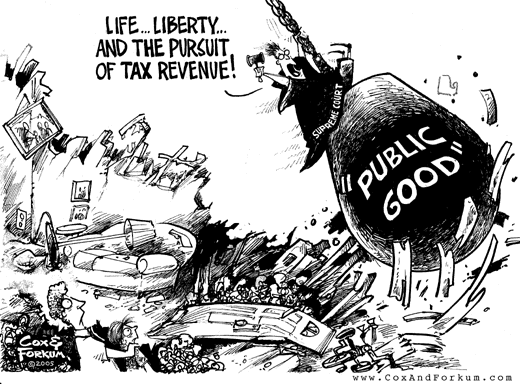
“No power on earth has a right to take our property from us without our consent.”—John Jay, first Chief Justice of the United States
“How ‘secure’ do our homes remain if police, armed with no warrant, can pound on doors at will and … forcibly enter?”—Supreme Court Justice Ruth Bader Ginsburg, the lone dissenter in Kentucky v. King
If the government can tell you what you can and cannot do within the privacy of your home, whether it relates to what you eat, what you smoke or whom you love, you no longer have any rights whatsoever within your home.
If government officials can fine and arrest you for growing vegetables in your front yard, praying with friends in your living room, installing solar panels on your roof, and raising chickens in your backyard, you’re no longer the owner of your property. If school officials can punish your children for what they do or say while at home or in your care, your children are not your own—they are the property of the state.
If government agents can invade your home, break down your doors, kill your dog, damage your furnishings and terrorize your family, your property is no longer private and secure—it belongs to the government. Likewise, if police can forcefully draw your blood, strip search you, and probe you intimately, your body is no longer your own, either.
This is what a world without the Fourth Amendment looks like, where the lines between private and public property have been so blurred that private property is reduced to little more than something the government can use to control, manipulate and harass you to suit its own purposes, and you the homeowner and citizen have been reduced to little more than a tenant or serf in bondage to an inflexible landlord.
Examples of this disregard for the sanctity of private property—whether in the form of one’s home, one’s possessions, or one’s person—abound. Here are just a few.
In San Rafael, California, it is now illegal to smoke a cigarette or other tobacco product inside “apartments, condos, duplexes, and multi-family houses.” Although lawmakers hope the ordinance will be “self-enforcing,” they’re encouraging landlords to threaten tenants with eviction should they run afoul of the law.
In Ohio, it’s illegal to alter one’s car with a hidden compartment if the “intent” is to conceal illegal drugs. Although Norman Gurley had no drugs on his person, nor in his car, nor could it be proven that he intended to conceal drugs, he was still arrested for the “crime” of having a hidden compartment in the trunk of his car.
In Florida and elsewhere throughout the country, home vegetable gardens are being targeted as illegal. For 17 years, Hermine Ricketts and Tom Carroll have tended the vegetable garden in their front yard, relying on it for 80 percent of their food intake, only to be told by city officials that they must get rid of it or face $50 a day in fines. The reason? The vegetable garden is “inconsistent with the city’s aesthetic character.”
In Iowa, a war veteran attempting to wean his family off expensive corporate farm products, GMOs and pesticides has been charged with violating a city ordinance and now faces up to 30 days in jail and a $600 fine for daring to raise chickens in his backyard for his personal use, despite statements of support from his neighbors.
In Virginia, school officials suspended two boys for the remainder of the school year and charged them with possession of a firearm after they were reported to the police for playing with toy airsoft guns in their front yard, while waiting for the morning school bus. At no time did the boys attempt to take the toy guns on the bus or to school.
The most obvious disrespect for property rights comes in the form of the tens of thousands of SWAT team raids that occur across the country on a yearly basis. Usually undertaken under the pretense of serving a drug warrant, these raids involve police arriving at a private residence in SWAT gear, armed to the hilt, kicking down doors, apprehending all persons inside the home, then determining if a crime has been committed. That was Judy Sanchez’s experience when FBI agents investigating gang activity used a chainsaw to cut through her door, then forced Sanchez and her child to the ground. It was only after invading Sanchez’s home and terrorizing her family that agents realized they had targeted the wrong address.
Unfortunately, we in America get so focused on the Fourth Amendment’s requirement of a warrant before government agents can invade our property (a requirement that means little in an age of kangaroo courts and rubberstamped warrant requests) that we fail to properly appreciate the first part of the statement declaring that we have a right to be secure in our “persons, houses, papers, and effects.” What this means is that the Fourth Amendment’s protections were intended to not only follow us wherever we go but also apply to all that is ours—whether you’re talking about our physical bodies, our biometric data, our possessions, our families, or our way of life. However, in an 8-1 ruling in Kentucky v. King (2011), the U.S. Supreme Court sanctioned SWAT teams smashing down doors of homes or apartments without a warrant if they happen to “suspect” you might be doing something illegal in your home.
At a time when the government routinely cites national security as the justification for its endless violations of the Constitution, the idea that a citizen can actually be “secure” or protected against such government overreach seems increasingly implausible, while suggesting that a person take steps to secure his person and property against the government could have one accused of fomenting anti-government sentiment.
Nevertheless, the reality of our age is this: if the government chooses to crash through our doors, listen to our phone calls, read our emails and text messages, fine us for growing vegetables in our front yard, jail us for raising chickens in our backyard, forcibly take our blood and saliva, and probe our vaginas and rectums, there’s little we can do to stop them. At least, not at that particular moment. When you’re face to face with a government agent who is not only armed to the hilt and inclined to shoot first and ask questions later but also woefully ignorant of the fact that he works for you, if you value your life, you don’t talk back.
This sad reality came about as a result of our being asleep at the wheel. We failed to ask questions and hold our representatives accountable to abiding by the Constitution, while the government amassed an amazing amount of power over us, and backed up that power-grab with a terrifying amount of military might and weaponry, and got the courts to sanction their actions every step of the way.
However, once the dust settles and you’ve had a chance to catch your breath, I hope you’ll remember that the Constitution begins with those three beautiful words, “We the people.” In other words, there is no government without us—our sheer numbers, our muscle, our economy, our physical presence in this land. There can also be no police state—no tyranny—no routine violations of our rights without our complicity and collusion—without our turning a blind eye, shrugging our shoulders, allowing ourselves to be distracted and our civic awareness diluted.
So where do we begin? How do we go about wresting back control over our freedoms and our lives in the face of such seemingly insurmountable odds?
There’s an old adage, albeit not a very palatable one, that says “when eating an elephant take one bite at a time.” The point is this: when facing a monumental task, take it one step at a time. In other words, we’re going to have to wage these battles house by house, car by car, and body by body. Most importantly, as I point out in my book A Government of Wolves: The Emerging American Police State, we’re going to have to stop the partisan bickering—you can leave that to the yokels in Congress—and recognize that the suffering brought about by a police state will be the great equalizer, applying to all Americans, regardless of their political leanings (the fact that we are all now being targeted for government surveillance is but a foretaste of things to come).
As John Adams rightly noted, “The Revolution was effected before the war commenced. The Revolution was in the minds and hearts of the people. This radical change in the principles, opinions, sentiments and affections of the people was the real American Revolution.”
It’s time for a second American Revolution. Not a revolution designed to kill people or tear down and physically destroy society, but a revolution of the minds and souls of human beings—a revolution promulgated to restore the freedoms for which our founders sacrificed their fortunes and their lives.
Learn more about John W. Whitehead at www.rutherford.org.
Read More and Comment: Obama Abolishes Private Property

No comments:
Post a Comment